Airflow vs Dagster vs Prefect: Choosing a Data Orchestrator
A production-focused comparison of task, asset, and flow orchestration across backfills, testing, deployment, observability, and team fit.

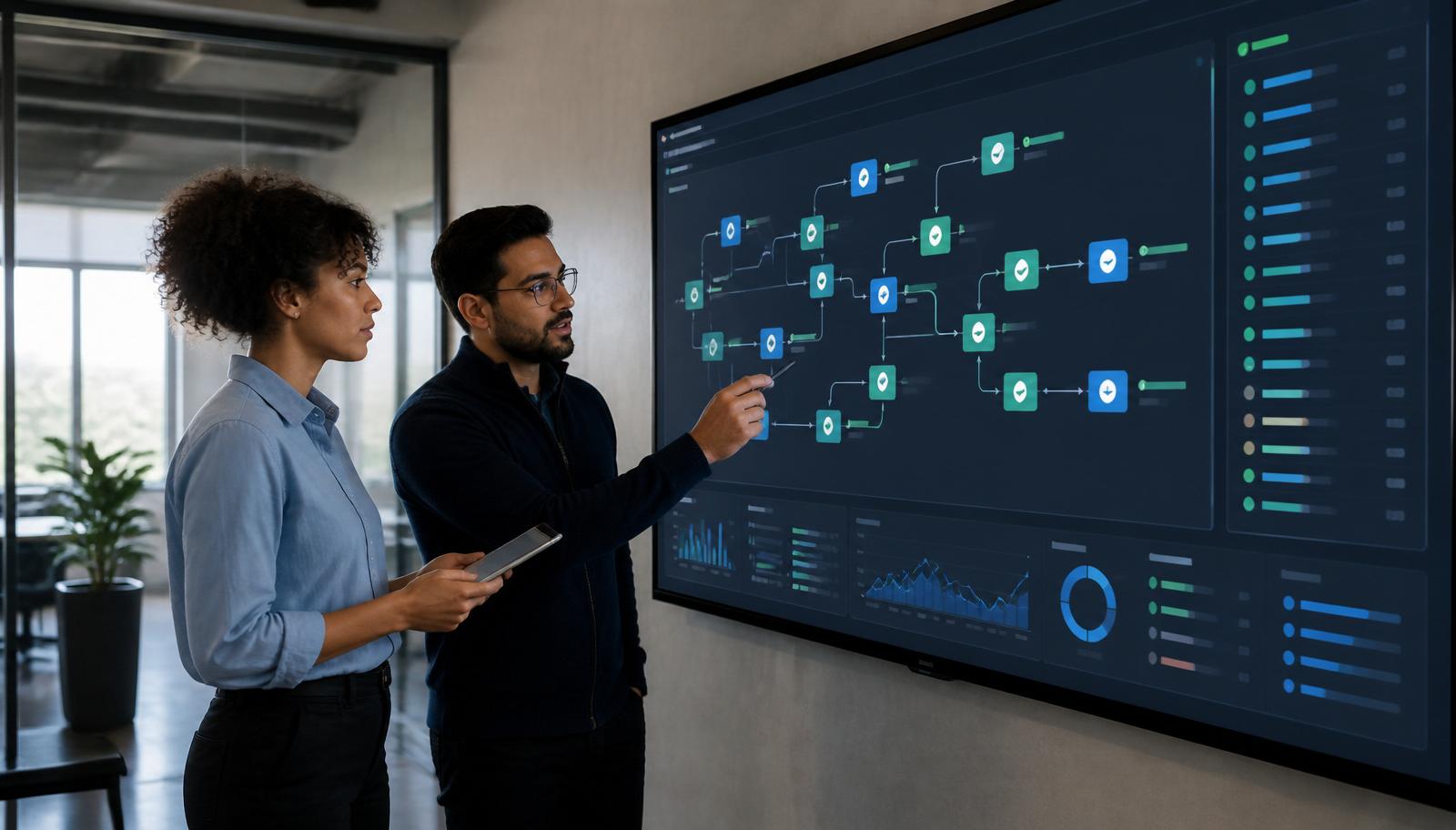
The choice is an operating-model decision
Airflow, Dagster, and Prefect can all schedule Python, retry failed work, expose a user interface, and run on managed infrastructure. A feature checklist therefore produces a misleading tie. The meaningful differences are how each product represents work, how naturally it models data dependencies, and how much platform engineering a team must supply around it.
Apache Airflow starts from tasks arranged in directed acyclic graphs. Dagster starts from software-defined data assets and the computations that materialise them. Prefect starts from normal Python functions organised into flows and tasks. Those abstractions influence backfills, lineage, tests, ownership, and how engineers diagnose partial failure.
Choose for the work you operate most often. A large organisation with hundreds of existing DAGs, a broad operator ecosystem, and dedicated orchestration administrators faces a different decision from a small data platform team building a new analytics estate with strong data-product ownership.
Airflow: ecosystem depth and operational weight
Airflow remains the safest compatibility choice. Its provider ecosystem covers virtually every warehouse, cloud, database, and transformation tool. Experienced operators are easier to hire, and managed offerings such as Amazon MWAA, Google Cloud Composer, and Astronomer reduce—but do not eliminate—the work of operating schedulers, metadata databases, workers, and upgrades.
The task-and-DAG model is understandable, but data semantics are often implicit. Two tasks may exchange files or tables without the orchestrator understanding that a durable asset changed. Datasets and newer scheduling capabilities improve this, yet many estates still depend on naming conventions, external lineage tools, and institutional knowledge.
Airflow is strongest when compatibility, existing investment, and predictable scheduled batch workflows outweigh developer ergonomics. It is weakest when teams expect local Python execution to behave like production automatically, or when dynamic data assets and frequent backfills are central to the product.
Dagster: data assets as the control plane
Dagster makes an explicit bet that data teams should reason about assets—tables, models, files, and reports—rather than only tasks. Dependencies, partitions, freshness expectations, metadata, owners, and materialisation history belong to the asset graph. This can collapse several separate catalog and orchestration conversations into one system.
The developer experience is deliberate. Definitions are normal Python, resources can be substituted in tests, and local execution provides a close representation of the production graph. Partition-aware backfills and asset checks are particularly useful for teams that repeatedly reprocess historical data or need to prove that an output meets quality expectations.
The trade-off is ecosystem and migration cost. Integration coverage is smaller than Airflow's, although major systems are well served. Adopting the asset model also asks teams to redesign how they describe pipelines; mechanically wrapping every old task preserves migration speed but gives up much of the reason to move.
Prefect: Python-first flow orchestration
Prefect is the least opinionated of the three about the shape of a data platform. A flow can look like ordinary Python and acquire retries, caching, mapping, state tracking, deployments, and remote execution incrementally. That makes it attractive for teams orchestrating machine-learning jobs, API workflows, infrastructure automation, or data processes that do not fit a static DAG cleanly.
Dynamic branching and parameterised execution feel natural because the Python runtime remains visible. The local-to-remote path is usually shorter than with traditional Airflow deployments, and work pools provide a flexible boundary between the control plane and infrastructure controlled by the user.
That flexibility can become inconsistency. Without conventions, one team creates reusable tasks while another hides an entire application inside one flow. Lineage and data-asset semantics are not as central as in Dagster, so organisations that want the orchestrator to serve as a data catalog may need additional tools or stricter modelling discipline.
Backfills and partial failure
Backfills reveal the true quality of an orchestration design. Ask how the system represents partitions, how operators select a failed range, whether upstream data is immutable, and what happens when only one asset in a daily partition must be regenerated. A button labelled ‘rerun’ is not enough when the workload can duplicate charges or overwrite a verified dataset.
Airflow can backfill scheduled intervals reliably, but complex cross-DAG dependencies and dynamic mapping require careful design. Dagster's partition and asset selection model gives operators a data-centric view of the affected range. Prefect makes custom parameterised reprocessing straightforward, though the team must define more of the data semantics itself.
Regardless of tool, tasks must be idempotent or protected by explicit transaction and deduplication controls. Record input versions, code versions, output destinations, and run identifiers. The orchestrator can coordinate recovery; it cannot repair a pipeline whose writes are unsafe to repeat.
Testing and local development
Evaluate a real pipeline, not a hello-world example. Can an engineer run one transformation locally with fake credentials and a temporary database? Can the dependency graph be validated without starting the entire platform? Can retry and failure hooks be tested deterministically? The answers matter more than how attractive the graph looks in a demonstration.
Dagster has the strongest integrated testing story because resources, assets, and partitions are first-class definitions. Prefect stays close to ordinary Python and is easy to test when flows are kept thin. Airflow testing has improved, but production parity often depends on plugins, environment variables, executor behaviour, and provider versions that are cumbersome to reproduce on a laptop.
Pin orchestration and provider versions, run graph validation in CI, and test one representative integration against an ephemeral service. Mocking every external boundary produces fast tests but misses authentication, schema, and pagination failures—the problems that dominate real pipeline incidents.
Deployment and total operational cost
Self-hosting any orchestrator means owning upgrades, metadata retention, secret delivery, worker capacity, observability, disaster recovery, and the boundary between user code and the control plane. Kubernetes does not make those responsibilities disappear; it turns them into manifests and alerts.
Managed services are often economical below the scale where a dedicated platform team is justified. Compare the complete cost: control-plane fees, worker compute, data egress, log retention, support, and engineering time. Also test the exit path. Pipeline definitions should live in your repository, use portable storage contracts, and avoid proprietary features whose replacement cost has not been accepted consciously.
Airflow offers the broadest managed-provider choice. Dagster Cloud provides a closely integrated asset experience. Prefect Cloud keeps execution infrastructure flexible through work pools. Security review should cover where code runs, where metadata is stored, how credentials reach workers, and which control-plane outage modes can pause production work.
A decision framework by team shape
Choose Airflow when you have a substantial DAG estate, depend on long-tail provider integrations, need a large hiring pool, or must align with a cloud-managed standard. Modernise the deployment and authoring conventions before assuming a migration will solve process problems.
Choose Dagster for a greenfield or modernising data platform where assets, partitions, quality checks, and lineage should be central to how teams work. It is especially compelling when backfills and data-product ownership are frequent operational concerns.
Choose Prefect when workflows are Python-heavy, dynamic, and broader than conventional warehouse pipelines, and when the team values a gradual path from local functions to managed orchestration. Whichever tool wins, run a four-week proof with one unreliable real pipeline, one historical backfill, one credential rotation, and one simulated worker failure. The boring failure path will tell you more than the feature matrix.
Reader questions, answered
Should an existing Airflow team migrate to Dagster or Prefect?+
Only when a measured limitation justifies the rewrite. A healthy Airflow estate with strong conventions is usually safer to modernise in place than to migrate for developer experience alone.
Which orchestrator is easiest for a small Python team?+
Prefect usually has the gentlest path from local Python to remote execution. Dagster can be the better investment when the team is specifically building a data-asset platform.
Can these tools replace dbt?+
No. They coordinate work and can invoke dbt, but dbt owns SQL transformation modelling, testing, and documentation. The products solve overlapping but distinct problems.
Raza Ahmad is a technology author and IT infrastructure specialist based in Melbourne, Australia. He writes practitioner-grade guides on cloud computing (Azure and AWS), cybersecurity, enterprise networking with Cisco platforms, Linux administration, DevOps, and virtualization. His work focuses on translating complex infrastructure topics into clear, accurate guidance that engineers, system administrators, and IT decision makers can put to work in production environments. Every article published under his byline is fact-checked against current vendor documentation, official standards, and Raza's own hands-on experience operating the technologies he covers.
More from Software Engineering

Top 10 ICT Companies Hiring H-1B Workers in 2026: Sponsors, Salaries, Roles
A detailed 2026 breakdown of the ten largest ICT employers of H-1B visa holders — approvals, median salaries, top job titles, hiring hubs, and how each company runs its sponsorship pipeline based on the latest USCIS and Department of Labor disclosure data.

Testing Strategy in 2026: What Actually Replaced the Test Pyramid
The test pyramid has been dying for a decade. Here's the testing shape that modern engineering teams have converged on, and why.
Clean Architecture in TypeScript: A Pragmatic Guide
Clean architecture without the cargo cult. A working TypeScript reference for separating business logic from frameworks, databases, and HTTP.
One email. The technology stories that actually matter for engineers.
A curated digest of the week's most useful tutorials, reviews, and analysis — no clickbait, no AI summaries of someone else's work.
Free. Unsubscribe anytime. See our privacy policy.