Autonomous AI Data Centers: Who Is Really in Charge When the Lights Stay On?
Inside the silent, sensor-saturated facilities where machine learning models now make split-second operational decisions — and why human oversight still matters more than ever.

The lights never go out
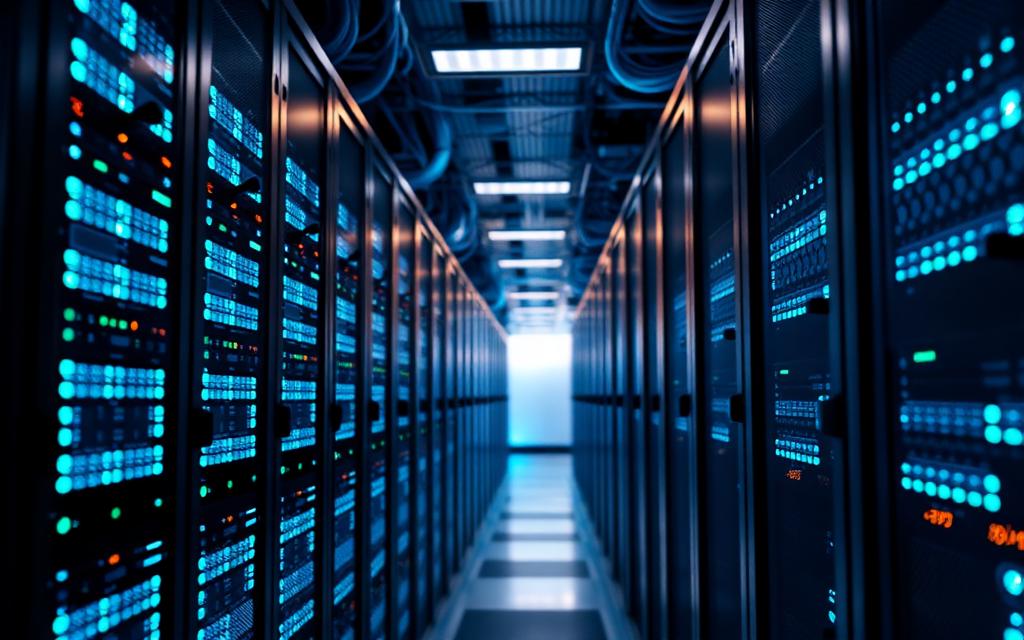
The lights never go out inside a modern data center. Behind secured doors and rows of towering server racks, millions of calculations happen every second. Every online purchase, video call, banking transaction, cloud application, and AI chatbot depends on these facilities operating without interruption. For decades, teams of engineers have monitored these environments around the clock. But a new era is emerging — one where artificial intelligence doesn't simply assist humans; it begins making decisions on its own.
Imagine walking into one of the world's largest data centers late at night. The corridors are almost silent except for the constant hum of cooling fans. There are very few people in sight. Instead, cameras continuously scan every movement, sensors monitor temperatures down to fractions of a degree, robotic systems transport replacement hardware, and AI software analyzes billions of data points every minute. Everything appears perfectly controlled. Yet one question lingers: who is really in charge?
How AI is transforming data center operations
Artificial intelligence is transforming the way data centers operate. Modern AI systems can predict hardware failures before they occur, optimize electricity usage, balance workloads across thousands of servers, detect unusual network activity, and even recommend maintenance schedules. Tasks that once required large teams of experienced engineers can now be completed in seconds by machine learning models trained on years of operational data. The promise is compelling: lower costs, greater efficiency, reduced downtime, and faster response to unexpected events.
Technology companies are investing billions of dollars into AI-powered infrastructure because even a few minutes of downtime can cost millions. AI can identify subtle warning signs that humans might overlook, such as tiny fluctuations in processor temperatures or unusual traffic patterns that suggest an impending hardware failure. By acting early, AI helps prevent outages before customers ever notice a problem.
The rise of the lights-out facility
As these systems become more sophisticated, the vision of a fully autonomous 'lights-out' data center is becoming increasingly realistic. In such facilities, human intervention is minimal. AI controls cooling systems, adjusts power distribution, schedules software updates, allocates computing resources, and continuously monitors security threats. Engineers may only step in when physical repairs are required. For many organizations, this represents the future of cloud computing.
However, automation introduces a different kind of risk. AI systems are only as reliable as the data, algorithms, and policies that guide them. If an AI model misinterprets information or receives inaccurate data, it may make decisions that are technically logical but operationally harmful. Unlike humans, AI does not pause to question its own assumptions unless it has been specifically designed to do so.
A 4:17 a.m. cautionary tale
Consider a fictional scenario. At 4:17 a.m., an autonomous monitoring system detects what appears to be coordinated malicious activity across several server clusters. Based on its training, the AI concludes that a cyberattack is underway. Within seconds, it isolates critical network segments, powers down storage arrays to protect data, reroutes workloads, and blocks administrator access to prevent further compromise. The problem is that there was no attack. A faulty sensor combined with a software update produced misleading signals that the AI interpreted as a severe security incident.
The consequences spread rapidly. Businesses lose access to cloud services, hospitals experience delays in accessing medical records, financial institutions suspend online transactions, airlines struggle with booking systems, and thousands of companies face unexpected downtime. Engineers race to restore operations, but reversing automated decisions across multiple interconnected systems takes valuable time. What began as a single incorrect assumption triggered a chain reaction affecting millions of users. Although fictional, this scenario illustrates why human oversight remains essential even in highly automated environments.
New attack surfaces, old skills at risk
Cybersecurity presents another challenge. As organizations increasingly rely on AI, attackers are adapting their methods. Instead of targeting only servers or applications, cybercriminals may attempt to manipulate the AI models themselves. By feeding carefully crafted data into monitoring systems or exploiting weaknesses in machine learning algorithms, attackers could influence automated decisions without directly compromising traditional security controls. Protecting AI has become just as important as protecting the infrastructure it manages.
Another concern is the gradual loss of human expertise. If AI performs most operational tasks, future engineers may have fewer opportunities to develop the practical experience needed during emergencies. When automation encounters situations outside its training, skilled professionals must still understand the underlying systems well enough to diagnose problems and make informed decisions. Human judgment remains difficult to replace, particularly during unexpected events.
Governance, ethics, and the new engineer
There are also ethical and governance questions to consider. Should AI be allowed to make decisions that could interrupt healthcare systems, emergency services, or financial networks without human approval? How much authority should organizations delegate to autonomous systems? As AI capabilities expand, governments, regulators, and technology companies will need to establish clear guidelines defining where automation should end and human responsibility should begin.
Despite these concerns, AI is unlikely to replace data center professionals entirely. Instead, it is reshaping their roles. Engineers are becoming supervisors of intelligent systems rather than operators performing repetitive tasks. Their responsibilities increasingly focus on designing reliable automation, validating AI decisions, strengthening cybersecurity, and responding to situations that require experience, creativity, and critical thinking.
A partnership, not a handover
The future of data centers will almost certainly involve even greater collaboration between humans and artificial intelligence. AI will continue to improve efficiency, reduce operational costs, and help prevent failures before they happen. At the same time, organizations must ensure that autonomous systems remain transparent, secure, and accountable. The most resilient infrastructure will not be built on automation alone but on a carefully balanced partnership between intelligent machines and skilled professionals.
The question is no longer whether AI will transform data centers — it already has. The real question is whether humanity can maintain control as these systems become increasingly capable. The future may not belong solely to humans or machines. It may belong to those who understand when to trust artificial intelligence, and when to step in before a perfectly logical decision becomes a costly mistake.
Reader questions, answered
What is an autonomous or 'lights-out' data center?+
A facility designed to run with minimal on-site staff, where AI systems handle cooling, power, workload placement, patching, and security monitoring. Humans typically only intervene for physical repairs or for incidents the automation explicitly escalates.
Can AI really replace data center engineers?+
Not in the foreseeable future. AI is excellent at pattern recognition and repetitive optimisation but poor at reasoning about novel failure modes. Most operators are shifting engineers into supervisory, design, and incident-response roles rather than removing them.
What is the biggest risk of automating data centers?+
A confident wrong decision. When automation acts within seconds across many interconnected systems, a single bad input — a faulty sensor, a poisoned model, a misapplied policy — can cause an outage that is materially harder to unwind than a human-driven mistake.
How are attackers targeting AI-managed infrastructure?+
Through data poisoning of monitoring inputs, adversarial examples that confuse anomaly detection, and supply-chain attacks against the model artefacts themselves. Defending the model is now part of defending the data center.
Raza Ahmad is a technology author and IT infrastructure specialist based in Melbourne, Australia. He writes practitioner-grade guides on cloud computing (Azure and AWS), cybersecurity, enterprise networking with Cisco platforms, Linux administration, DevOps, and virtualization. His work focuses on translating complex infrastructure topics into clear, accurate guidance that engineers, system administrators, and IT decision makers can put to work in production environments. Every article published under his byline is fact-checked against current vendor documentation, official standards, and Raza's own hands-on experience operating the technologies he covers.
More from IT Infrastructure
Backup Strategy in 2026: Why 3-2-1 Became 3-2-1-1-0
Ransomware killed the old 3-2-1 backup rule. The 3-2-1-1-0 model that replaced it is what a modern, defensible backup strategy looks like.
VMware vs Proxmox in 2026: An IT Infrastructure Comparison
Post-Broadcom VMware licensing has rewritten the virtualization decision for many organizations. Here is how Proxmox VE compares for real-world workloads.
Linux Server Hardening Checklist for 2026
A practical, current hardening checklist for production Linux servers — identity, kernel, network, logging, and the controls that actually reduce risk.
One email. The technology stories that actually matter for engineers.
A curated digest of the week's most useful tutorials, reviews, and analysis — no clickbait, no AI summaries of someone else's work.
Free. Unsubscribe anytime. See our privacy policy.